
PFD Bench by lyfX.ai
You didn’t become a process engineer
to write documentation.
Upload a Process Flow Diagram. Get an accurate process description in minutes, not hours.
What engineers say

K-UTEC AG Salt Technologies, Germany
Every process diagram tells a story.
Writing it down shouldn’t take all day.
Turning process diagrams into documentation is a typical bottleneck every engineering team knows but nobody talks about.
📋
Manual cataloging
Listing every equipment item, tag, and stream by hand
🔗
Tracing connections
Following inlets, outlets, and recycle loops one by one
✍️
Writing descriptions
Translating visual flow into consistent, accurate prose
🔄
Updating everything
Redoing it all when the diagram changes
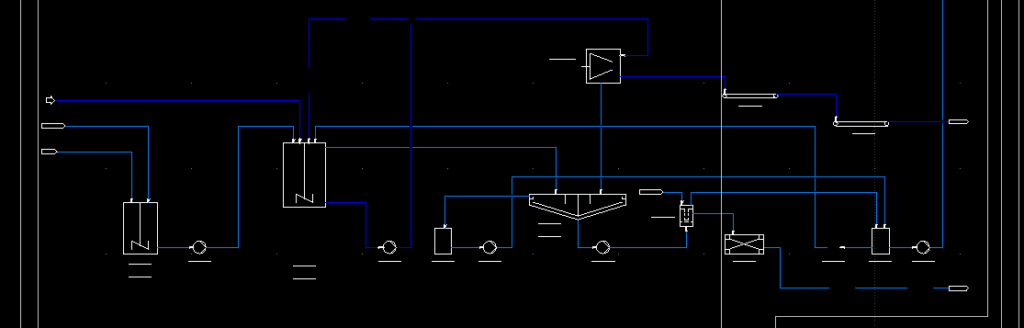
PFD Bench reads diagrams like an engineer.
Structural parsing, not pixel reading. That’s why it works on complex, real-world PFDs.
①
Upload
Standard DXF export from your CAD tool (AutoCAD, MicroStation, etc.)
②
Extract
Equipment, tags, and connections, parsed from structure, not pixels
③
Verify
Cross-check for consistency with a human-in-the-loop review step
④
Generate
A process description you can edit, refine, and export
95%+
equipment identification, measured – see the benchmark
Why engineers love PFD Bench
⚡
From hours to minutes
What took half a day becomes a quick review. Your engineers spend time on engineering, not transcription.
🎯
Consistent & complete
Standardized output every time. Fewer missed tags, fewer “did we include everything?” moments.
🔒
Your data, your server
Dedicated deployment: on-premise or single-tenant VM. Your diagrams never touch shared infrastructure.
“Can’t I just use ChatGPT?”
| Capability | General-purpose AI | PFD Bench |
|---|---|---|
| Simple PFDs (< 10 items) | Rough draft | ✓ |
| Complex PFDs (dozens of items, recycle loops) | ✗ | ✓ |
| Parses diagram structure (not just image) | ✗ | ✓ |
| Cross-checks connections automatically | ✗ | ✓ |
| Benchmarked accuracy on real industrial diagrams | ✗ | ✓ |
| Human-in-the-loop verification | ✗ | ✓ |
| Dedicated deployment / data privacy | ✗ | ✓ |
We built PFD Bench because general-purpose AI was not good enough. We know it because we tried it first.
See what PFD Bench saves your team
Drag the sliders to match your team’s workload
Includes review and revision time.
Frequently Asked Questions
How can I test it?
We offer free evaluation access here, no credit card needed, so you can test with your own PFDs and make an informed decision.
We have taken great care to ensure that confidentiality is fully respected. Please see our free trial FAQ for more information.
What happens to my data during the free trial?
We have taken great care to ensure that confidentiality is fully respected. Please see our free trial FAQ for more information.
How do you deal with my confidential diagrams?
We have taken great care to ensure that confidentiality is fully respected, no matter if in a shared server or a dedicated one.
However, if you want to be 100% sure, we offer dedicated deployments: your diagrams stay on your infrastructure, no shared servers. The only data leaving your environment are the API calls to state-of-the-art LLMs. We also plan to offer on-prem LLMs for processing your data.
How accurate is PFD Bench?
PFD Bench identifies equipment at 95%+ accuracy and maps connectivity at ~90% on typical drawings (F1, measured over 10 runs per drawing, based on actual industrial drawings). On the densest, most interconnected plants some branch connections can be missed. Exactly for this reason the built-in verification step lets you catch and correct before the description is generated. See here our full benchmark.
What file formats are supported?
DXF exports from standard CAD tools (AutoCAD, MicroStation, COMOS, etc.). PDF support is on the roadmap.
Can I edit the generated descriptions?
Yes. The output is fully editable before export. You have complete control over the final document.
How much does it cost?
We offer free evaluation access here, no credit card needed, so you can test with your own PFDs and make a more informed decision. After you evaluated it, please contact us for discussing your needs and we will make a proposal.
Can I use it for P&IDs too?
Yes. We release it in Summer of 2026 as beta. We are working on its accuracy report (for PFD accuracy report, see here).
Built in collaboration with process industry engineers

Dr. Andre Moreira
Co-founder & Managing Director, lyfX.ai
With a PhD in Physics and over a decade at BASF working across chemicals, fertilizer, and energy, Andre built PFD Bench because he understood the bottleneck firsthand. At lyfX.ai, he applies state-of-the-art AI to solve real problems in process industries. PFD Bench is the tool process engineering teams wished existed earlier.
How PFD Bench started
It began in December 2024, when an engineer from our partner K-UTEC AG Salt Technologies asked if we had a good prompt for turning a process diagram into a written description.
We tried it over a Saturday morning with the first vision-capable AI models. For a very simple PFD, it worked. Then reality hit. On real-world PFDs (complex, dense, with dozens of equipment items) the errors were too many. It wasted time rather than saving it.
So in mid-2025 we started building PFD Bench: a dedicated tool that parses diagram structure, cross-checks connections, and uses carefully engineered prompts to deliver reliable results. Getting from “curious demo” to 95%+ accuracy on complex diagrams took more work than we expected.
But every process engineering team we talked to had the same bottleneck. So we turned it into a product.
 EN
EN  DE
DE  PT
PT  ES
ES