
CAPEX Engine by lyfX.ai · Early access
Describe the plant.
Get a costed process design you can defend.
CAPEX Engine is an AI working environment for chemical engineers. Write a briefing. An agent builds the block flow diagram, refines it to unit operations, then selects and prices equipment from a real equipment database. Interactively.
In use on real engineering projects. Early-access seats are limited.
Concept-phase costing still runs on tribal knowledge.
The concept phase decides most of a plant’s lifetime cost. The tools that serve it have barely changed: a block diagram on a slide, a factor file in a spreadsheet, and a senior engineer’s memory of what the last plant cost.
01
The number nobody can trace
02
One alternative at a time
03
Knowledge that is lost over time
Equipment costs get scaled from an old project and pasted into a spreadsheet. Six months later nobody can say where they came from.
Every variant means another week of sizing and lookups. So alternatives rarely get compared, and the first idea wins.
The sizing rules and the vendor prices live in people’s heads, not in the estimate. When they retire, the estimate retires with them.
One run. Three gated phases. You hold the gate.
You write a briefing in plain language. The agent reads it back, asks before it builds, and then works through three phases. Nothing advances until you say so.
0
Briefing
1
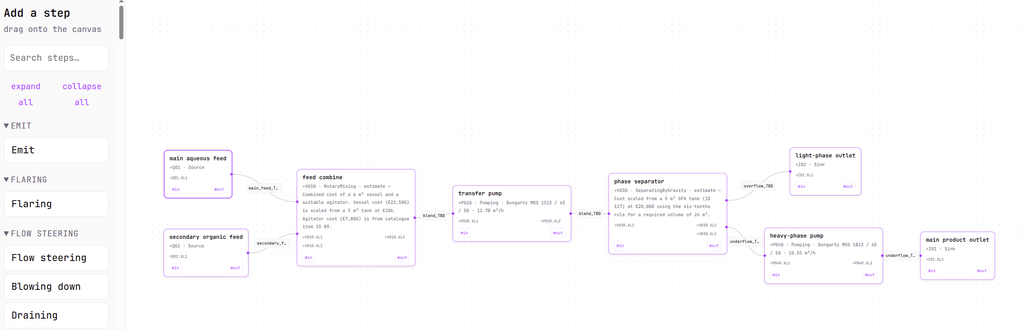
High-level BFD
2
Detailed BFD
3
Equipment selection
Briefly explain what you have in mind. That is enough to start. The agent confirms what it understood and asks about anything ambiguous before it creates a single block.
Sources, sinks and the main process blocks, connected by streams with material templates. Coarse on purpose.
Every block refined down the DEXPI taxonomy to concrete unit operations. Quantities carry design or operating mode and their provenance.
Each unit operation matched to catalogue equipment, priced with its basis year, CEPCI-adjusted, and rolled up into an itemized summary with a total.
At every gate: advance · revise · back one phase · pause. Resume days later with the full context intact.
An agent you work with, not a form you submit.
Watch
Watch it think
Every reasoning step and every tool call streams live in the terminal. Interrupt, correct or redirect at any point.
Edit
Edit the graph
Open the run in the interactive graph editor. Your edits flow back to the agent and become part of the design.
Resume
Pick up later
A finished run is a paused run. Ask the agent for a summary, a variant or a justification weeks later.
Every number tells you where it came from.
A concept estimate is only useful if a senior engineer can check it. CAPEX Engine is built so that they can.
Catalogue picks are verified. Each equipment line references a real record in the equipment database (831 entries across 27 equipment types). The database row is authoritative for cost and description. The agent cannot invent a catalogue entry.
Estimates are declared. Where no catalogue match exists, the line is flagged as an estimate with its basis, and subtotals are shown separately.
Utilities are line items. Cooling water, motors and agitators get their own picks instead of disappearing inside a reactor cost.
Quantities carry provenance. Specified by you or calculated by the agent, design or operating mode: every value says which.
| Step | Equipment | Catalogue | Cost | Basis year |
|---|---|---|---|---|
| =R010 · vessel | Reactor vessel, 11.76 m³, alloy 904L | #98 verified | 182,828 EUR | 2017 |
| =R010 · agitator | Pitched-blade agitator | #74 verified | 34,400 EUR | 2018 |
| =P020 | Centrifugal pump, 8 m³/h | #168 verified | 3,312 EUR | 2017 |
| Total | 220,540 EUR | |||
verified = catalogue row checked at attach · estimate = declared estimate with its basis, subtotalled separately
Stirred-tank neutralization, lyfX test run. The agent’s closing note: “All equipment has been selected from the catalogue, and no cost estimates were used.”
Built on DEXPI Process, not on a private format.
Every run produces a DEXPI Process document: the open, CC-BY standard for process descriptions, built on ISO 10628 and ISO/IEC 81346. Around 100 process-step classes, typed ports for material, thermal, mechanical and electrical flows, and tag names that follow DIN 6779-13.
Export the document as standard XML and open it in any DEXPI-compatible tool. Your design is yours.
DEXPI Process · ISO 10628 · ISO/IEC 81346 · DIN 6779-13 · Proteus XML export
What you get in early access
✓ Hosted instance with access control for your team
✓ Interactive graph editor and a run summary with itemized costs
✓ Onboarding session and a direct line to the people who build it
✓ Projects, sub-projects and full run history, shareable with colleagues
✓ Choice of model per sub-project: Claude, GPT, Gemini or DeepSeek
✓ Standard XML export of every design
We onboard a small number of early-access teams at a time, so every team gets hands-on support and a say in what gets built next.
Where it goes next
In design
Your agent in the engineer’s seat
An MCP interface, so that Claude or your in-house agent can drive a run and read its results. The engineering stays server-side.
Planned
Drop in a diagram
Start a run from an existing block or process flow diagram instead of a written briefing.
Planned
OPEX and ROI on the same graph
Operating costs and payback on the design you just costed, as part of AutoGraph.
Built with the engineers who use it
CAPEX Engine is developed by lyfX.ai together with process engineers at a German engineering partner, who run it on live projects and shape what gets built next. lyfX.ai was founded by Dr. Andre Moreira, a physicist with over a decade at BASF across chemicals, fertilizer and energy.
Common questions
What do I need to start a run?
A written briefing: what comes in, what goes out, what happens in between, in plain language. Placeholders are fine. The agent reads the briefing back and asks before it builds.
Where do the prices come from?
From an equipment database with 831 entries across 27 equipment types. Each catalogue price carries its basis year and is CEPCI-adjusted. Where no catalogue match exists, the agent declares an estimate with its basis, and the summary keeps catalogue and estimated subtotals apart.
What kind of estimate is this?
A concept-screening estimate, Class 5 in AACE terms: the number you need to compare alternatives and decide whether a project moves forward, with an audit trail behind every line.
Can’t I just ask ChatGPT?
You can, and you will get a plausible number with no trail behind it. A chat model has no equipment database, no process model and no gate. CAPEX Engine constrains the agent with an open standard, verified catalogue picks and your approval at every phase.
How is it different from a process simulator?
A simulator needs a converged flowsheet and thermodynamics. CAPEX Engine works earlier, at the block and unit-operation level, and answers a different question: what does this plant need, and what does it cost. It comes before rigorous simulation, not instead of it.
Which AI models does it use?
You choose the model per sub-project: Claude, GPT, Gemini or DeepSeek. Long runs are compacted automatically so the agent keeps its context.
Do I need to know DEXPI?
No. You write in plain language and the standard works underneath. Engineers who know ISO/IEC 81346 tag conventions will feel at home in the graph.
What about confidentiality?
Your runs live on a lyfX-hosted instance with per-team access control. The only data that leaves it are the API calls to the model you chose. A dedicated deployment on your infrastructure is available on request.
How much does it cost?
Early access is agreed in a conversation, not on a price list. Book a short call and we will walk you through it.
 EN
EN  DE
DE  PT
PT  ES
ES