
Andre Moreira, Claude AI and ChatGPT
NB: this is a co-authored document; when “I” is mentioned, it means “Andre” (the only human co-author).
We (Claude and I) recently ran a quick internal inventory on all of Andre’s CLAUDE.md files, chats under Claude AI and ChatGPT and other AI-related work we have been doing (e.g. my personal implementation of FuzzyClaw, for every day use). After discussing the findings, we created this document, which serves 3 purposes:
- How much of my (Andre’s) everyday work changed in the past 2 years? Beyond the coding and chatting use cases, how much has AI agents really influenced how we work? Being itself an “AI first” company, how much of our own “dog food” do we eat?
- Create some clarity for ourselves on what can be unequivocally classified as productive AI agentic work.
- Inspire people in our network and beyond with these findings: maybe you are already using AI agents? Or maybe some of the things we mention here are also useful for you?
The document contains a description of what is already happening, not what we plan to do.
Two things to keep separate as you read:
- How we use AI — which has four distinct modes, each with its own value and its own appropriate provider.
- What we use it for — which maps to a recognizable org chart of departments and roles.
1. Four modes of using AI
These are not tiers of sophistication; they coexist and we use all four every day. Mixing them up is what makes the picture sometimes feel chaotic or “not agentic”.
Mode 1 — AI as chatbox
One-shot, conversational, transient. No persistent context, no automation, no tools attached (except for internet searching when more updated context is needed). You bring a small unit of work — an email to polish, a phrase to translate, a tone to soften — and the model gives you back a better version of the same thing.
- Provider matters by style preference, not capability. I often use ChatGPT for most chatbox work because the prose style fits better. The tools are interchangeable enough at this size that taste wins.
- No memory needed. The interaction starts and ends in one screen.
- Volume is high; effort per interaction is low. This is the bulk of casual AI use, even though it adds up to a small share of the agentic work.
This mode is minimally agentic (the model may decide by itself to fetch extra information from online sources, making it agentic).
Mode 2 — AI as second brain
Conversational but high-context, often a long session. Used as thinking partner: sparring on app architecture, debugging logic, brainstorming a positioning pivot, stress-testing a concept, working out what’s missing from a proposal.
- Examples: architecture discussions for AutoGraph or FuzzyClaw, business-model exploration, grant-strategy framing, post-mortems on a pitch.
- Provider matters more here. Claude for code reasoning and architecture; GPT for narrative framing or when semi-obsessive attention to detail matters; Gemini for research and work that needs long context windows. I routinely run the same question through more than one provider.
- Value: faster and deeper thinking than working alone, catches blindspots, doesn’t tire when you do. Closest to “having a non-judgmental colleague to think out loud with.”
Like Mode 1, this mode is minimally agentic for the same reasons.
Mode 3 — AI as generic agent, made specific by skills
This is where the agentic story actually starts, and it’s the most important shift of the last twelve months.
Claude (especially in Claude Code) is a generic engine. Skills are what turn that engine into a lyfX-shaped colleague. A skill is not a prompt. A skill bundles, in one folder:
- Instructions on when and how to act
- Tooling conventions (which tools to use, in what order, with what defaults)
- Examples and few-shot anchors from real lyfX work
- Helper scripts where deterministic logic is faster than tokens (this is a point many people miss, and is a skill’s “superpower”)
- Output formats and house style
- Organizational defaults
The same generic agent becomes the expense processor, the VM operator, the grant reviewer, the post-call analyst, the WordPress builder, the corporate-design custodian — depending on which skill is loaded. Each is repeatable, version-controllable, shareable, and adapted to how lyfX actually works.
We currently have ~60 such skills, ranging from cross-cutting infrastructure (ai-dev-workflow, committing git code, code-hygiene) to deeply lyfX-specific ones (lyfx-vm-checkups, lyfx-corporate-design, astra-wp-builder, fireflies-debrief, client-project-brief, post-call-analysis).
The point is that skills are how we encode taste, defaults, and SOPs into something the AI can carry forward. The same generic agent runs an entire department’s worth of work, repeatably, because of the skills. This is the cheap, organic agentic layer.
Mode 4 — AI as specialized agent (purpose-built)
Production-grade software where AI is core, not assistive. The agent has its own runtime, its own memory, its own UI, often its own UX with end users (clients or internal staff).
Two flavors:
Inside FuzzyClaw (lyfX’s own orchestration platform):
- Fuzzy — the always-on assistant: message board, platform queries, web search
- Shenlong / Wani — memory-on / memory-off generalist specialist with a wide range of tools it can use (our own containerized version of OpenClaw)
- market-researcher, web-scraper, career-scraper — purpose-built scrapers/researchers
Outside FuzzyClaw, as products in their own right:
- PFD Bench — DXF → process flow descriptions; 3-agent pipeline (Worker → Auditor → Generator)
- CAPEX Engine (under development) — block diagram → equipment specs + cost estimates; Projector → Agent → Materializer pipeline
This is the product layer — what we sell, what we deliver, what runs without us watching.
Why this matters
It is genuinely useful to ask, of any AI interaction: which mode is this?
- A two-minute prompt to rewrite an email is Mode 1. It does not deserve a folder, a skill, or a name.
- A 40-minute architectural argument with Claude is Mode 2. It does not deserve a folder either, but the output (a decision, a design_notes.md) does.
- A monthly run of expense processing is Mode 3. It deserves a skill, and it has one.
- PFD Bench is Mode 4. It deserves everything a product deserves.
Findings — Inventory of Agentic Work (Jan 2025 → May 2026)
Sources mined:
- ~/.claude/projects/ (47 project folders, ~95 memory files)
- all CLAUDE.md files under Andre’s personal laptop
- ~/.claude/skills/ (60+ skills)
- ~/Documents/fuzzy-lyfx/ (the live personal FuzzyClaw instance we use day to day).
Activity mix (rough, mapped to the six departments below):
- Tech & Product ≈ 45%
- Finance ≈ 20%
- Strategy & BD ≈ 20%
- Ops & Infra ≈ 10%
- Marketing & Design ≈ 3%
- Staff & EA ≈ 2%
Caveat: Marketing as well as Staff & EA is heavily under-counted — most of its real volume is Mode 1 (email polish, tone editing, quick rewrites) running in ChatGPT and Claude AI web. Counted across all providers, it would probably be the second-largest department after Tech & Product.
2. The “departments”, as they actually “exist”
What follows is the org chart as it is already organized — not a structure to enforce, but a way of seeing what is already organic. Each department is the natural grouping of work; for each, we note which mode of AI use dominates.
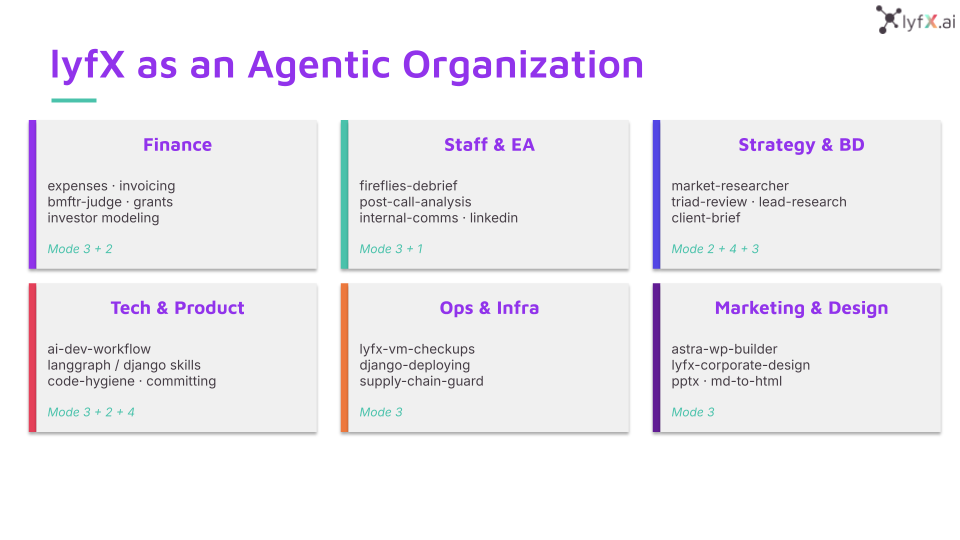
Finance
- Activity: expense processing, invoicing, quote/proposal writing, grants, investor financial modeling, business plan review.
- Dominant modes: Mode 3 (skills like expenses, project-quotes-writing) + Mode 2 (financial modeling and grant strategy as sparring sessions).
- State: mature and in regular productive use.
Staff / Personal Assistant
- Activity: Fireflies debriefs, post-call analyses, follow-up emails, internal comms, LinkedIn posts.
- Dominant modes: Mode 3 (fireflies-debrief, post-call-analysis, client-project-brief, internal-comms) + Mode 1 (everyday email polish, mostly via ChatGPT, polishing linkedin-posts).
- State: mature for calls and comms; email and calendar have MCP connectors wired but no recurring agentic workflow yet, more punctual use for now.
Strategy & Business Development
- Activity: market research, lead research, BD pipeline analysis (Trello), pitch reviews, project briefs from meeting transcripts.
- Dominant modes: Mode 2 (heavy — strategic sparring) + Mode 4 (specialized agents: market-researcher in FuzzyClaw) + Mode 3 (triad-review, analyzing-lyfx-trello-board).
- State: the most multi-modal department; the same question often goes through second-brain framing, then a triad-review pass, then a specialized scraper.
Technology & Product
- Activity: all coding.
- Dominant modes: Mode 3 (heavy — ai-dev-workflow governs nearly every coding session, plus the langchain/langgraph/deep-agents/django skill families) + Mode 2 (architecture, debugging, design_notes.md sessions) + Mode 4 (the outputs — PFD Bench, CAPEX Engine — are themselves specialized agents).
- State: mature. It is also the largest department by volume.
Operations & Infrastructure
- Activity: VM health checks, deployments, supply-chain hardening, hook policy administration, the claude-mem cross-session memory system.
- Dominant modes: Mode 3 (lyfx-vm-checkups, django-deploying, supply-chain-guard) + Mode 1 (quick infrastructure questions).
- State: mature; runs on demand and on schedule.
Marketing & Design
- Activity: WordPress page building, brand consistency on documents and decks, large PPTX rebuilds, lyfX.ai website work.
- Dominant modes: Mode 3 (astra-wp-builder, lyfx-corporate-design, pptx).
- State: mature and in regular productive use.
R&D / Lab
- Activity: hackathons (e.g. MessMiner), prototypes (DönerWatch, exploring NanoClaw as an alternative to OpenClaw), framework learning (LangChain Academy, DLAI Claude Skills), exploratory clones.
- Dominant modes: Mode 4 (most prototypes become specialized agents) + Mode 2 (using AI as tutor).
- State: mature; some prototypes graduate into products.
4. What we learned and where we go from here
The shape of lyfX as an agentic organization is that Mode 3 (generic agent + skills) is doing the heavy lifting for departments, while Mode 4 (specialized agents) is the product line, and Modes 1 and 2 are the everyday operating texture. The skills layer — 60+ representing our encoded taste — is the under-appreciated piece: it’s the closest thing lyfX has to “institutional knowledge” in machine-usable form. FuzzyClaw is the orchestration layer for the non-tech, non-interactive parts.
If only one thing from this exercise survives, it should be the four-mode distinction. It is genuinely useful to be able to look at any AI interaction and ask: which mode is this? The answer tells you whether it deserves a skill, a folder, a name, or just two minutes of attention. A lot of the confusion about “how much AI do you really use?” dissolves once you stop treating chatbox edits and a production agent as the same thing.
In practical terms, this means a two-person company today runs with the surface area of what would have needed a small team as recently as two years ago. The departments above are not roles we hired into — they are the work that is already happening, done by a generic agent that has been carefully tuned to each. The implication for how lyfX grows from here is less “hire one person per department” and more “invest in the skill layer so a future colleague can plug into the existing setup without having to re-learn my taste.”
As we continue our journey, we will likely move some of the most-used skill sets into named FuzzyClaw agents so these can run independently, uninterrupted, in scheduled runs without an interactive layer as I have, for instance, with Claude Code. It is notable that I feel increasingly comfortable providing the agents with more and more autonomy and access: for instance, Claude can now access my Google Drive so we can work on a document in the cloud in parallel; this very document is the living proof of it. This bears some obvious risks (giving broad access to an agentic system that could be misconfigured, compromised, or simply act too confidently?) and some that I am sure I don’t know about. On the other hand, having a human colleague with a “12345” password for their email is also a major risk. So where do we draw the line?
Looking back, the trajectory is clear: 2024 was the year chatbox and second-brain became second nature; 2025 was the year skills made the agent specific to our work; 2026 is shaping up to be the year of scheduled, autonomous agents that I trust enough to leave running.
 EN
EN  DE
DE  PT
PT  ES
ES